

This was my second trip to Kashmir, also in the middle of winter. It was, as last time, freezing cold.
There are two sides to Kashmir: the poet Amir Khusro’s immortal Moghul wonderland or ‘Paradise on earth’ sadly juxtaposed against a valley filled with bitterness and pain, a people homeless and despairing .
Which is the real Kashmir?
I had only ever seen Srinagar bleak, grey, cloaked in snow. This time, lucky me, the snow had vanished and the city seemed in limbo: not quite hushed by the winter.
The people of Kashmir I barely know, except hotel staff and touts at tourists spots selling ski lessons, winter clothes on rent and pony rides. They are all universally good-looking, tall and fair and distinctively different from the rest of the sub-continent. Their Persian, Greek, Afghani ancestry is echoed in their fair-skinned, rosy-cheeked faces. Their dark eyes seem resigned, devoid of much joy or hope. They struggle every day with all the things we take for granted: freedom to move around any hour of the day or night, good roads, electricity, phone lines and running water, supermarkets, night life and all the trappings of the age we live in.
Which is why Kashmir is still stuck in a time warp of vintage splendor twisted by modern angst.
Its people are not happy. They have been forsaken and forgotten by politics and power struggles. Many of the men have spent a few seasons in Goa, living off the tourist trade, either peddling Kashmiri handicrafts or working in hotels. None of them enjoyed their time there, having gone to find work and care for their families.
Kashmir is still the most awe-inspiring place I have ever been too. Even the wild and pristine Argentina comes a far second to the romance and magnificence of Kashmir, with its Mogul gardens, it’s towering snow-capped Himalayas, the lines of birch and maple that stand like wizened sentinels in the dead of winter. Tall pine trees and meadows of crisp, white snow; endless skies of turquoise, worthy of the Mediterranean, broken only by jagged mountain peaks. Ponies bedecked like brides trot along trails, and smiling, red -faced children in shabby woollen surcoats smilingly walk to school. There are large kashmiri men in billowing, traditional winter coats over their kangras (little clay pots of live coals worn under their woollen robes). I didn’t see many women out and about. Little girls in school uniforms, a few young women in colourful woollen, embroidered kurtas and headscarves; a few chattering women manning a chemist counter and a rare lady at the reception in the hotel. Otherwise the women seem to be safely hidden behind doors.
What you can’t miss is the presence of the Indian army. Look around and there are bunkers, small patrols, uniformed men in full combat gear, armed with lethal rifles. They are standing watch over streets: look up at the nearest rooftop, they are at checkpoints and behind lead barriers. It’s sad. It shouldn’t be this way. But it is.
The Dal lake in Srinagar is vast, placid and echoes with Shammi Kapoor’s legendary song, “taareef karoon kya uski, jisne time banaya…” ( “Shall I praise the One who made you…”).
Shikharas ply the gentle waters, ferrying locals between houseboats and the mainland, or taking honeymooning Indian tourists for their own moment of magic in a kitschy, slender wooden gondola, bedecked with red velvet hangings and ornately carved wooden fixtures.
My boatman gave me a small glass of local salt tea that he had just brewed on the shikhara as he took me on a solitary viewing of an orange sunset over the limpid water. Lotus flowers floated by like nymphs. The silence was like balm, utterly soothing, with only the waves lapping gently at the boat as we rowed to the ruined bridge perched like a prop in a painting, over the horizon. The tranquility was broken only by the incessant chatter of the boatman who tried coaxing me into a much longer excursion to the floating market (immortalised by Shammi Kapoor in the aforementioned song of the film, Kashmir ki Kali).
I quelled the urge to shut him up, and reluctantly exchanged phone numbers with him. He compounded all his sins thus far by pleading for a tip since whatever I had paid up would go to the owner of the boat. I shrugged and gave him one of my brand new 200 rupee note (yes, the new one, just released).
I never did return to the lake.
Instead I spent my days with the film crew as they travelled to one location more beautiful than the last, finding that perfect valley, that untouched white snow drift, an eerie forest, that magical vista of the mountains…….
The best morning was spent with the only other woman on the trip, Estelle. She is gorgeous, blonde-haired and blue-eyed and a dear friend. She is more desi than most desis I know and can outsing anyone to any Bollywood song!
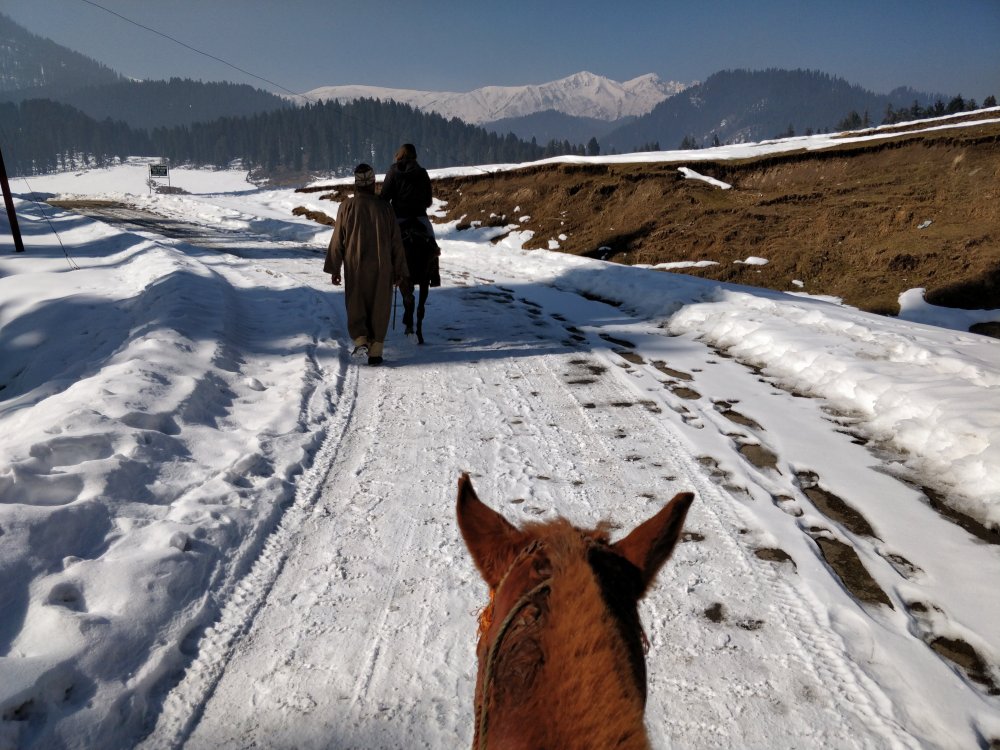
The two of us were very out of place with the all-male crew who were having a man-moon on a car film with gadgets and toys and nothing but crazy hard work, something they all thrive on. Deemed frivolous to the location scout at hand, Estelle and I were sweetly plonked onto two poor little local ponies and sent up an iced-over road as the Masters of the Universe requisitioned the only available gypsy and sumo up the hill to get to the beautiful valley of Doodhpatri.
And as all good things happen unexpectedly, Estelle and I had the most marvellous hour basking in the gentle morning sunshine as we clip-clopped our way through a forest of pine trees and snow, valleys below.
We were disappointed to realise our trek was nothing but a gentle pony ride, not some exciting adventure cross-country. Still, it was the best little adventure. Sighing and giggling as we ambled along, posing for cheesy photos, and laughing with sheer joy at being alive in this winter wonderland, the morning became a special memory. It didn’t matter that it was bitterly cold and our hands were frozen on the bridle. It was just us, the ponies and their two horsemen who led us under the wide, blue sky.
Yes, Kashmir is devastatingly beautiful and deserves much more. Heaven really is a place on earth!
 Thewanderingindiangourmet