
Last night I dreamed I went to Concha again.
Walking up the wide, polished red stairs, I shake silvery sand off my bare feet. Waves break on the seashore in the distance, music plays from the bar at Royal’s. The sun is shining from a bright blue sky, and a smattering of coconut trees sway gently. The old house has never looked prettier. Or more welcoming. Two grand casuarinas stand sentinel at the generous front entrance, where the stairs begin, and you can just glimpse the antique Portuguese lamp strung from the centre of the porch. It is white glass and metal, handmade, and beautiful.
Everything is just as I remember.
Something pulls me inside, past the tall bamboo reception desk, and into the high-walled passage. Past bright posters of pretty airline girls fishing in exotic islands, a library of books in many languages left behind by guests, is a beautiful old map of Goa with the old delineations.
Tata Hannalore and Danielle are sunbathing in their balcao, room #1, Quarto de Calangute. I hear them chattering in French, out by the bright hibiscus blossoms. They have gorged on fresh papaya and pots of black tea after their morning ritual swim, with a walk to Fort Aguada and back. They are now turning a beautiful deep caramel from Paris winter white, with sun-kissed blonde hair and typical red vernis on their elegant fingers. I am fascinated by how easy they are topless, and in their many bikinis all day, or wrapped simply in an Indian sarong. Such effortless chic. And Tata’s smoky blue eyeliner, so signature.
I notice the floral crockery on the glass cane tables in the garden. Hitakari fine bone china, several different full service tea sets in brilliant florals, tropical and elegant. I will be fascinated by elegant tea sets for the rest of my life. And by elegant bathroom tiles, and boutique hotels and balinese style verandahs and showers, because that is how Concha was: a melting pot of my Papa’s travels across the world- Spain, Portugal, Indonesia and more.
I continue down the vaulted lime-washed corridor. Above me, glass orbs from Chor Bazar hang from old beams. A hand-made, Portuguese style, wooden altar is the only decoration high above. It holds a statue of Mother Mary and the Baby Jesus, smiling placidly against vivid blue satin. A tiny lightbulb flickers yellow on the garish plastic rose inside.
Past all this, the garden beckons from beyond, green, a hundred shades of green, dappled in the sunlight. The bali-esque wooden trellis is bright green.There is a white well beyond it, and turtles reside within.
Sounds echo from the kitchen, further down towards the garden, and smells emanate, loud voices, pans clatter and sizzles and hisses. I walk towards it. I peep through the window and watch Mama as she expertly folds an omelette for old Vera. Cajetan is popping the toaster.
Outside on the lawn, Elmi is pouring tea as she chats with the lissome Effie who serves her homemade papaya jam. Vera, lovely old Vera from England smiles at us all. She looks happy at the prospect of another day by the sea.
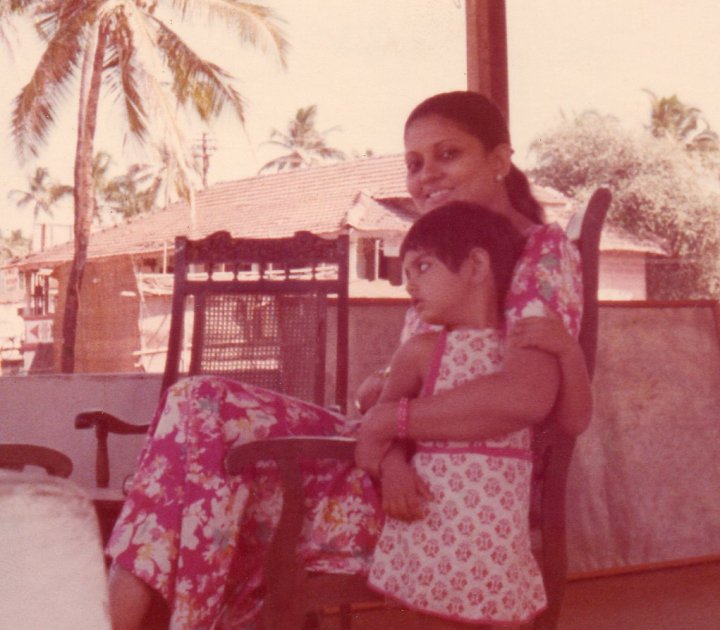


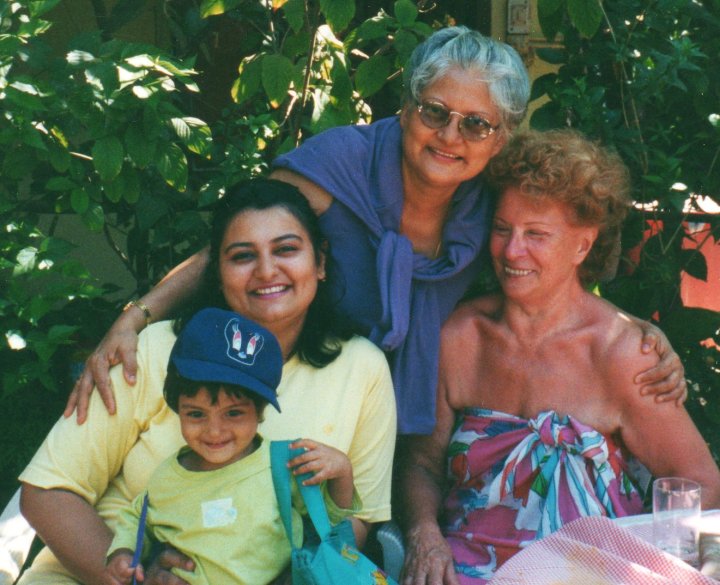
I see Papa sitting on his chair, his vantage point that look straight down the corridor, past me, past the porch, out to the deep blue sea and the endless horizon beyond. He is talking on his new Nokia mobile phone. He sees me and smiles broadly, waving out. I step aside to let a little child rush past me, soaking wet and shrieking, She has cropped hair, kajal in her eyes, wears a red polka dotted bikini. With a start I realise this child is me, five year old me.
The light wavers and everything shifts, my dream ends as the world tilts.
There are no voices now, only silence.
There are no curtains made from woven cotton saris fluttering from every room door.
No shadows dancing in the sea breeze on the ruby polished Mason floor.
My sandy feet leave no footprints- there is nowhere for them.
I am here standing before two broken steps that simply lead up to a large open space……….of nothingness.
From the once verdant garden Mama lovingly nurtured for thirty years, only a solitary casuarina tree remains. Stormy’s grave is here somewhere, under the scraggly bushes. He died alone but I came to bury him. No, not alone, Chintu was with him, she held vigil as he lay there under the altar, until we arrived by overnight bus from Pune. Another ghost to leave behind in this home that haunts me in my dreams still.

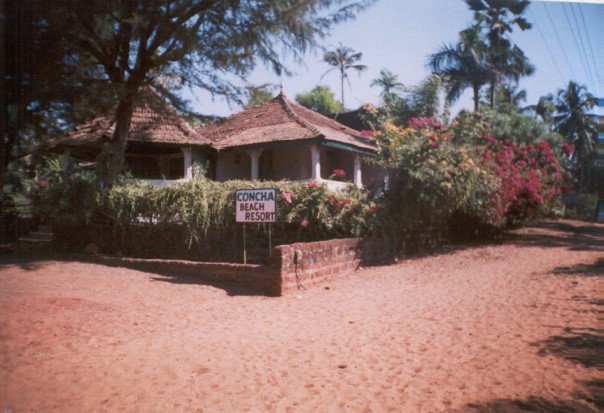
I would give anything to go back there as it once was, the centre of my happiness and the only home I ever knew.
To see my Papa in his element, charming the foreigners who wintered with us, graduating to close family over decades; Auntie/ Tata Hanna, Fr. Churchill, Elmy and Vera from London, the Italian nurses Violetta and Francesca, Isla Maria who went on to carve quite the niche for herself in Goa with her own properties as LouLou; Martin, the Swiss artist who did a series for Swatch, the American watercolorist David Rankin who painted Concha for us; and many, many friends and relatives who have so many fond memories of Concha from holidays spent here.
Concha is born in 1976, in Calangute Beach, the centre of North Goa, the original party place. There is Dinky’s bar, Santosh Cold Drink for fresh juices, a Bombay bhel puri stall, Ishmael’s Kashmiri shop, the Tourist Hotel and all that white sand beach. People flock for miles for Souza Lobo Sunday lunches and live concerts on the beach. It is a very, very different GOa, safe, happy and clean.
I would give anything to return and spend endless holidays swimming in the sea, eating fish and rice for lunch, fresh local coconut cakes or baatika, and slippery golden jackfruit. To gaze at the sunset from the old front goan balcao every evening.
To feast on rum-and-raisin brownies from the German hippie who sold them from big, old fashioned glass jars in the little tinto ( market). To cycle to the little library bearing home a bunch of Debbie-Mandy comics, Photo Romance magazines, stacks of them, with beautiful models like Maurizio Vecchi and Andrea (oh! my teenage heart sighs). We would spend days reading and reading without electricity, when all you had was comic books or dog eared novels and the beach to while away time.
I want to go to the village fests where everyone dances to the local band and drinks cocktails and Top Cola and top Orange, and makes merry, and you are safe, and all the kids make friends with one another, all the aunties are dressed in their best frocks and high heels, and the uncles sweat in their shiny Gulf- return suits, and everyone dances the old fashioned way: Cha-cha and waltz and jive and real dancing. The dance floor is surrounded by tables and chairs, with white table cloths and bottles of local Arlem beer. So what if it happens to be the local main street? Everyone is there, and the village is shut for the night anyway! Goa sure knew how to party, the old fashioned way, and we wore real dresses and looked pretty, and even participated in local beauty pageants and played dance floor games ( which were huge fun and I did win Miss Leo Princess at 14!!)
I want to be awake all night, forced to listen and sing along to off-key to the legendary weekend Jam sessions at my neighbour Royal’s Jam Sessions, watching the Hippies dance all night, at the height of the 80s Punk movement in leather, fluo, long braids. To hear “Footloose” for the tenth time that night, as I whoop with joy and run back on the dance floor despite my nervous preteen self. I had access to the latest and best music from Europe, all live and every weekend. Gosh. What a treat!!
It is all a time of innocence and childhood adventures: building sandcastles and collecting shells, long lunches at Souza Lobo for xacuti and thick finger chips, sannas and fried prawns,.
I even have a squealing pet piglet of my very own, Lucy, whom I adore. Years later I will watch Charlotte’s Web and weep every time. I miss Lucy always, little pink, squirming Lucy.
Most afternoons, I spend outdoors in the sand, playing with my friends under coconut trees. We don’t have many toys, happy with with old pieces of discarded pottery, a pretty cup, a chipped plate. There is Marie Lou from the famous Epicure restaurant next door, Gino’s daughter. We play with Arcangela, the fisherwoman’s little girl. Gino’s little boy is Aaron, the older brother whose name I cannot recall, ah, Adrian is more serious and watches us with disdain.
Maa takes us regularly on exciting local bus rides and ferry trips. We love these mornings, gallivanting across the countryside in big old buses, crammed with people, baskets of live hens, fresh fish and bushels of bananas. The Goan maushis wear beautiful kashta sadis. Their hair is oiled, plaited and tied with fresh flowers. The catholic aunties wear bright matching-matching floral skirts and blouses. They all speak Goan Konkani in singsong voices, smiles bright against beautiful cafe au lait skin. And all the while the bus conductor cries out, “mapusa mapusa,” rapidly in his sing-song voice. or “ponnji-ponnji-ponnji,” which my brother mimicks so well to our mirth back home. We learn to recognise places by their churches; the wedding cake, the grand castle, the simple chapel, the birthday cake, the meringue and so on. The backwaters are stunning, the ferry ride from Betim to Panjim is the most fun part.
It is sunset walks to Baga beach and back every evening before a dinner of ” mitango burgers’ from a new shack, or something fun from a local restaurant. Perhaps Simon, our wonderful malayali cook has actually made incredible Lobster thermidor, chow mein or chow mein again. I later find out it is was all Maa’s training, all he knows is roadside chinese and Russian salad and chips!
I belong to the world of the people around me, people like the fisherwoman Eleanora who always crushes me to her magnificent bosom with joy, each time I came home from Bombay. She smells of coconut oil and sunlight and dry fish, and her voice is a song. She is unfailingly warm, and kind and generous, as long as she lives. She weeps deeply when she hears of Papa’s death and my eventual loss of the property.
Concha is the summer without end, the chilly December with Christmas stars on every doorway and Midnight Mass at the local church. It is nights spent on the beach counting stars as a teenager, and long picnics in the sand with the Demello family, singing old songs like ‘Bang Bang Lulu and Knees up Mother Brown.’
Concha is swimming out to sea with my father, my little brother left safely on the shore. It is Django, the Doberman we have to give away to the Cordeiro family in Saligao, and long lunches at their colonial Portuguese home where I taste my first caldinho at a formal table and learn how to sip soup the old fashioned way, and never slurp. I spend all day crying for my Django left behind in their home, chained to a post on the verandah. I have never forgotten Django and every animal I adopt will never be given away. This is my promise to my beloved first dog.
Concha is the only home I will ever claim. The one constant in my gypsy world growing up, where I’ve seen myself fall in love and break my heart, and fall in love again before I even become an adult.
Concha is my love and my memory itself.
I often find myself walking down the whitewashed corridor, dreaming the exact same dream.
It is everything and now it is nothing.

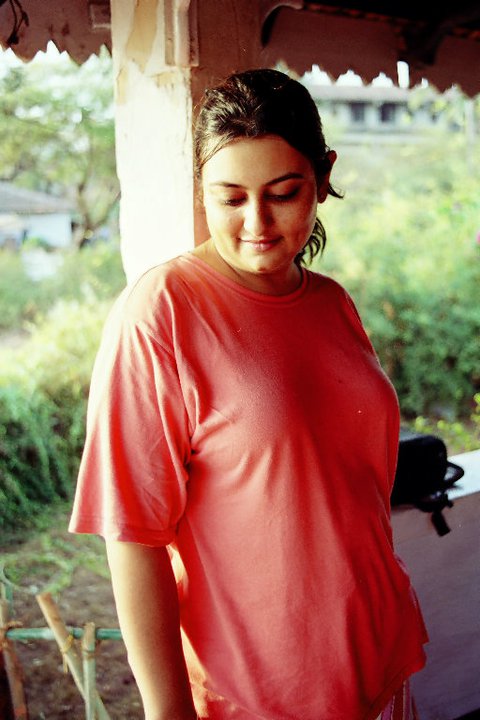


 Thewanderingindiangourmet
Ohhhh so evocative……….just love it Rads!!! Thank you for taking me to Concha with you!! 🥰
LikeLiked by 1 person
Thank you🌸🌸🌸🌸
LikeLike
That is fantastic dear radhika… Literally took me back to your childhood & I could easily viusalize everything thru your words! Beautiful!
LikeLike
this is so very kind of you Shu!
LikeLike